They Broke the Locks First: The Real Story at St. Sava Cathedral
- Dec 7, 2025
- 4 min read
Updated: Dec 15, 2025
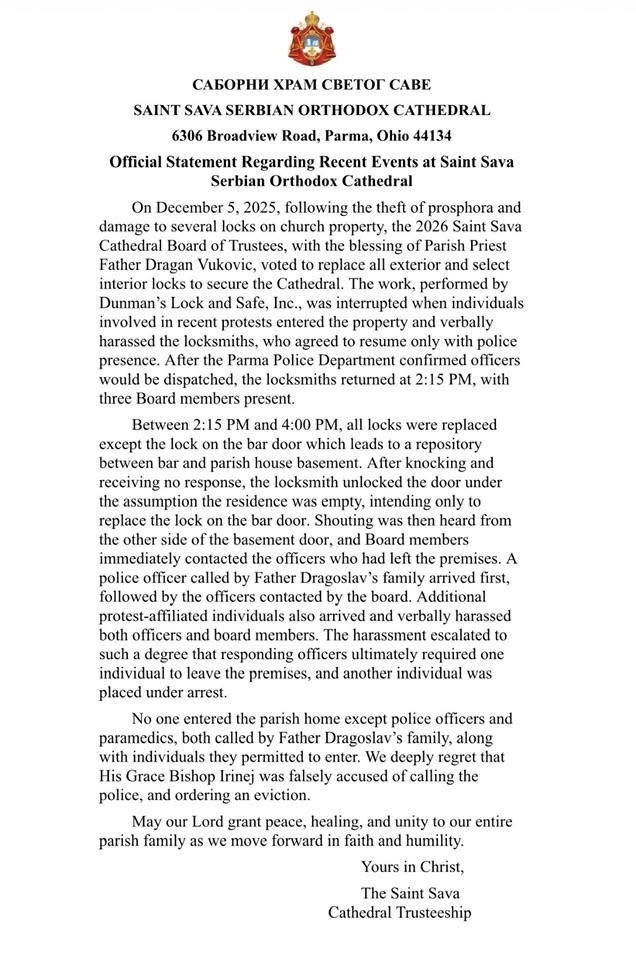
A recent article in SerbianTimes, headlined with accusations of a "break-in" and claims that a priest's family was "kicked out onto the street," has circulated widely among Serbian communities online. The piece is emotionally charged, rhetorically effective, and fundamentally misleading. It omits critical context, mischaracterizes routine church governance as acts of aggression, and frames a protest faction as the voice of the parish. The faithful deserve an accurate account of what occurred and why.
This is that account.
What Actually Happened
The week prior to December 5, during a scheduled Liturgy, one of the protesters broke locks across the church property and locked the front doors, preventing parishioners from entering for worship. This act of interference created an immediate security problem. Locks had been compromised. Entry points were no longer secure.
On Friday, December 5, the legitimately appointed Temporary Trusteeship acted to change all locks on the church campus. Police were present to ensure the process occurred peacefully and without confrontation.
That is what the SerbianTimes article calls a "break-in."
Father Dragoslav Kosić was canonically dismissed from parish duties on October 29. He has been on medical leave since October 31. Medical leave protects his health benefits and clergy status, it does not grant indefinite residence in parish housing or suspend the bishop's authority to assign a new priest. The family remains in the house. No one was placed "on the street." The Trusteeship secured church property; it did not conduct an eviction.
How the Church Actually Governs
For readers unfamiliar with Orthodox ecclesiology, a brief explanation is necessary.
A parish is not a congregational body that governs itself. The Serbian Orthodox Church is hierarchical. The diocesan bishop is the canonical rector of every parish in his diocese. He alone has authority to assign, reassign, or dismiss clergy. The Church-School Board exists to administer property and finances as a delegated body under the bishop's oversight, not as an independent authority that can override his decisions.
Parish housing belongs to the Church, not to the priest who occupies it. When a priest is reassigned or released from duties, residence in the rectory concludes so the incoming priest may take possession. This is universal Orthodox practice. It happens in every diocese, in every jurisdiction, whenever pastoral transitions occur. There is nothing unusual or punitive about it.
When the Diocesan Administrative Board, whose president is the bishop, appointed a Temporary Trusteeship, it exercised authority explicitly granted by the Statute of the Eastern American Diocese of the Serbian Orthodox Church. The Statute was approved by the Holy Assembly of Bishops, the highest legislative body of the Serbian Orthodox Church. The Trusteeship is the legitimate civil and ecclesial administrator of parish property. The protest faction's refusal to recognize this authority does not make the Trusteeship illegitimate—it makes the protesters schismatic in their orientation.
Where the Article Misleads
The SerbianTimes piece relies on several distortions that deserve direct correction. "Break-in" and "vandalism." Entering and securing property owned by the Church, carried out by the authorized Trusteeship with police oversight, is by definition lawful access. The protesters broke locks. The Trusteeship replaced them. Calling this a "break-in" inverts reality. The article also claims this was done "at the bishop's order." This is false. The Trusteeship, acting within its authority over parish property, made the decision independently after protesters broke the original locks.
"Kicking the priest and his four children onto the street." This is inflammatory and false. Securing locks is not an eviction. The family remains housed. The emotional image of children on the sidewalk is designed to provoke outrage, not to describe what happened. And about the priest's wife becoming ill during the incident—the video footage shows her lying on the ground while her daughter stood over her recording rather than helping. No one in the household moved to assist her. If someone is genuinely in medical distress, you help them. You don't film it. The optics suggest a scene staged for the camera.
"The rebellious parishioners constitute a large majority." This claim is asserted without evidence. The article itself notes that the new priest has been able to serve Liturgy (with police present due to protester interference). A true majority would not need to barricade doors to prevent services. Claiming majority status is a standard tactic of insurgent factions seeking to legitimize their defiance.
"The bishop installed members of a few families into the Board." The Diocesan Administrative Board has explicit canonical authority to appoint a Temporary Trusteeship when disorder or canonical violations arise. The protesters' preferred candidates were not "removed" by usurpation; they were replaced by lawful diocesan action after their faction physically interfered with worship and damaged church property.
The Real Danger
What is unfolding at St. Sava Cathedral is not a dispute over one priest's tenure. It is an attempt by a small faction to assert congregational control over a hierarchical Church—to decide for themselves who may serve, who may enter, and who governs parish property.
This is not how the Orthodox Church works. It is not how it has ever worked. When protesters break locks, barricade doors, and prevent the faithful from attending Liturgy, they are not defending tradition. They are attacking it. When they demand that the bishop reverse lawful decisions under threat of continued disruption, they are not petitioning—they are coercing.
The bishop and the Trusteeship have a duty to restore order, secure property, and ensure that the Divine Liturgy can be celebrated without obstruction. That is what they have done. The SerbianTimes article frames these necessary actions as aggression. In truth, the aggression came first—from those who broke the locks, blocked the doors, and turned a cathedral into a site of protest rather than prayer.
The faithful of St. Sava Cathedral deserve peace, order, and access to worship. They deserve leadership that upholds canonical discipline rather than capitulating to factional pressure. And they deserve accurate reporting—not sensationalized headlines that obscure the truth.
If anyone has photos and videos of the events occurring, please reach out to writer@orthodoxintegrity.org
May God grant wisdom, repentance, and reconciliation to all involved.
Read the full series on the St. Sava Cathedral situation: Blog

